Recovery and Removal Checks
Last modified 2014-04-14
Sini
Table of content
Recovery and removal analysis are done on asynchronous signals like resets. These specify the requirement of these signals with respect to clock.Recovery Time is the minimum required time to the next active clock edge the after the reset (or the signal under analysis) is released. Similarly, Removal Time is the minimum required time after the clock edge after which reset can be released. You are trying to make sure that the reset removal is not occurring for different flops for different clock edges, thereby creating functional/metastability issues. 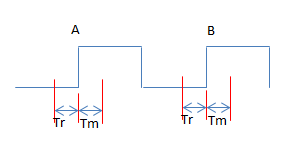

Let let us see how to read the timing reports. Given below is an example schematic. Look up the drill from Setup & Hold .

Recovery Slack = Data Required Time – Data Arrival Time
Data Arrival Time = Clock Network Delay to FF1 + Combination path delay to CLR of FF2. Data Required Time = Clock period + Clock Network Delay to FF2/CP - Tr of FF2.
For ideal clock, Tr is the time before the next clock edge the CLR input should be stable. This library removal time for CLK-CLR arc will be given in the .lib.
Startpoint: control/currentstatereg1 (rising edge-triggered flip-flop clocked by sclk) Endpoint: shiftregreg8 (recovery check against rising-edge clock sclk') Path Group: **asyncdefault** Path Type: max
Point Fanout Cap Trans Incr Path
clock sclk (rise edge) 0.0000 0.0000 clock network delay (propagated) 5.4068 5.4068 control/currentstatereg1/CP (SDFFCQX2) 1.1966 0.0000 5.4068 r control/currentstatereg1/Q (SDFFCQX2) 1.2736 1.2589 & 6.6656 r control/currentstate[1] (net) 6 0.0933 control/U5/Y (NAND2X1) 0.8768 0.4963 & 7.1619 f control/n37 (net) 2 0.0529 control/U31/Y (AOI22X2) 2.0933 1.2677 & 8.4296 r control/testmode (net) 8 0.2093 control/testmode (controlt1) 0.0000 0.0000 & 8.4296 r testmodei (net) rst/IN2 (ckrstt1) 0.0000 0.0000 & 8.4296 r rst/IN2 (net) rst/U8/Y (AOI21X1) 1.2645 1.0233 & 9.4529 f rst/n3 (net) 1 0.0457 rst/U9/Y (AOI21X1) 0.7661 0.5541 & 10.0070 r rst/nresetspc2 (net) 1 0.0136 rst/nresetspc2 (ckrstt1) 0.0000 0.0000 & 10.0070 r nresetspc2 (net) U77ICCplace/Y (BUFX3) 3.0074 1.8044 & 11.8114 r n87 (net) 15 0.4463 U78ICCplace/Y (INVX3) 1.9985 1.3313 & 13.1427 f n88 (net) 14 0.3073 nreset (spc2t1) 0.0000 0.0000 & 13.1427 f nreset (net) U72/Y (AOI21X1) 1.8788 1.1913 & 14.3340 r n194 (net) 4 0.0690 U216/Y (AND2X2) 1.7628 1.1913 & 15.5253 r n120 (net) 5 0.1476 U6ICCcts/Y (INVX3) 1.4885 1.0081 & 16.5334 f n461 (net) 13 0.2593 shiftregreg8/CLR (DFFCX2) 1.4873 0.0011 & 16.5345 f data arrival time 16.5345
clock sclk' (rise edge) 30.0000 30.0000 clock network delay (propagated) 2.8310 32.8310 shiftregreg8/CP (DFFCX2) 32.8310 r library recovery time -0.7776 32.0533 data required time 32.0533
data required time 32.0533 data arrival time -16.5345
slack (MET) 15.5188
Removal check is similar to the hold check explained here. You are checking this at the same clock edge, if the path is between two flip flops.
Removal Slack = Data Arrival Time – Data Required Time
Data Arrival Time = Clock Network Delay to FF1/CP + Combination path delay from FF1/Q to FF2/CLR Data Required Time = Clock Network Delay to FF2/CP + Tm of FF2 The library requirements will be available in the .lib file. Again, assuming ideal clock, the CLR input should not reach the FF2/CLR at least before the library removal requirement.
Startpoint: resetreg (rising edge-triggered flip-flop clocked by clkc) Endpoint: trimrefreshenreg (removal check against rising-edge clock clkc) Path Group: **asyncdefault** Path Type: min
Point Fanout Cap Trans Incr Path
clock clkc (rise edge) 0.0000 0.0000 clock network delay (propagated) 3.8572 3.8572 resetreg/CP (SDFFPQX2) 0.9145 0.0000 3.8572 r resetreg/Q (SDFFPQX2) 0.4055 1.0647 & 4.9219 f resetocsync2 (net) 2 0.0235 U27/Y (MUX2X2QQC1) 1.3584 1.3341 & 6.2560 f resetoc (net) 6 0.1814 resetoc (ckrstt1) 0.0000 0.0000 & 6.2560 f resetoc (net) IN1 (ckrstt1) 0.0000 0.0000 & 6.2560 f IN1 (net) trimrefreshenreg/CLR (SDFFCX2) 1.3584 0.0034 & 6.2594 f data arrival time 6.2594
clock clkc (rise edge) 0.0000 0.0000 clock network delay (propagated) 3.9515 3.9515 trimrefreshenreg/CP (SDFFCX2) 3.9515 r library removal time 0.0580 4.0095 data required time 4.0095
data required time 4.0095 data arrival time -6.2594
slack (MET) 2.2499